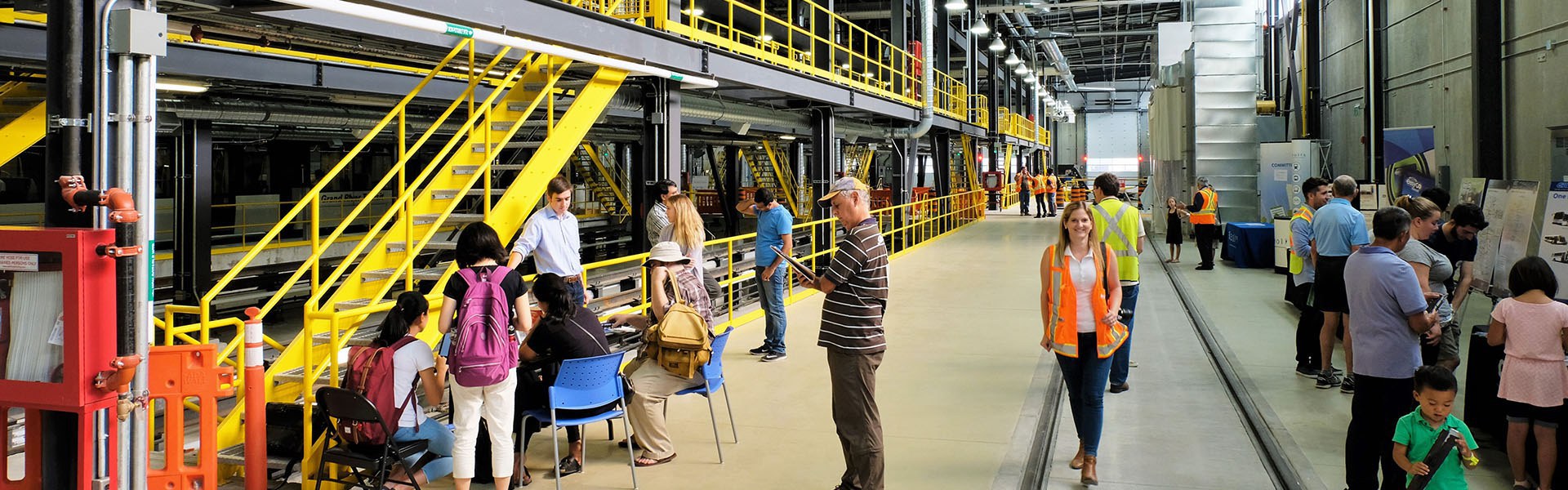
The only Binational Doors Open event – now in its 9th year!
Doors Open Niagara showcases the best of Niagara’s binational architecture, heritage and design. Join us this year as we focus on “The Visionaries Behind the Scenes” – the founders, architects, builders and special stewards of these built assets and the legacy they have left us.
For a complete listing of Doors Open Niagara sites and special events year-round, visit www.doorsopenniagara.ca or call 1-877-884-2736.
3292 Sixth Avenue, Jordan (905) 562-5235 www.npca.ca Architect: Macdonald Zuberec Ensslen Architects Inc.; Year Built: 2007-08
Dates/Hours Open:
Saturday: 9 a.m. to 4 p.m.
Sunday: 9 a.m. to 4 p.m.
Niagara’s first targeted Leadership in Energy and Environmental Design gold-certified building is located on the Niagara Escarpment. The centre, which showcases environmentally appropriate building design and operational practices, has received several awards, including a Sustainable Architecture & Building (SABMag) Award and the Niagara Community Design Award of Distinction.
Saturday: 10 a.m. to 4 p.m.
Sunday: 10 a.m. to 4 p.m.
Built in the 1820s as a home, later converted to a tavern and inn, this building on the grounds of the Battle of Lundy’s Lane has been restored to an 1850s tavern. Its design combines details from the mid-1880s regency and classical revival styles. Guided tours illuminate early tourism related to the War of 1812.
5071 Victoria Aveune, Niagara Falls (905) 358-6386 Architect: William Nichols; Year Built: 1910
Dates/Hours Open:
Saturday: 10 a.m. to 4 p.m.
Sunday: 10 a.m. to 4 p.m.
This library, built in 1910, is one of 111 built in Ontario between 1901-23. It features neoclassical details, including: a front portico with brick columns and an egg and dart motif; a central gable with a closed pediment; an entablature with flat modillions and a semicircular fanlight; and raised limestone.
Saturday: 10 a.m. to 4 p.m.
Sunday: 10 a.m. to 4 p.m.
Sunday service: 10 a.m.
Established in 1820, Holy Trinity was built in the historic village of Chippawa; the current building was built in 1841-42 on the foundation of the original church. The church contains two regency staircases, a semi-circular altar rail and magnificent stained glass. A cairn at the burial site of 1812 commemorates those lost in the Battle of Chippawa.
1499 Line 3 (at the Niagara Parkway), Niagara-on-the-Lake (905) 468-2187 x 5400 www.inniskillin.com Year Built: Brae Burn Barn, 1925
Dates/Hours Open:
Saturday: 10 a.m. to 4 p.m.
Sunday: 10 a.m. to 4 p.m.
Inniskillin is pleased to welcome visitors to its piazza and a newly designed hospitality area that includes a demonstration kitchen and the Riedel Room. The historic Brae Burn Barn, built in 1925, boasts a new, contemporary main entrance, a main-floor view of the cathedral loft, a newly designed boutique, tasting bars and the Vineyard Patio.
Saturday: 10 a.m. to 5:30 p.m.
Sunday: 10 a.m. to 5:30 p.m.
Built in 2001 as a state-of-the-art facility for winemaking, the Jackson-Triggs winery represents a postmodern interpretation of traditional farm buildings. The design emphasizes the natural and technical processes of winemaking. Exterior views encompass surrounding vineyards and the breathtaking Niagara Escarpment.
Saturday: 10 a.m. to 4 p.m.
Sunday: 10 a.m. to 4 p.m.
Laura Secord was a pioneer in Upper Canada. Her heroic actions during the War of 1812 have resulted in her becoming an enduring icon of Canadian popular culture and a designated Person of National Historic Significance. The home from which she began her famous walk has been restored to the 1812 era with authentic period furnishings.
Saturday: 10 a.m. to 4 p.m.
Sunday: 10 a.m. to 4 p.m.
This restored home of rebel and publisher William Lyon Mackenzie, built in the 1820s, showcases 500 years of printing technology. The rarest item in the museum’s collection is the Louis Roy press, the oldest press in Canada and one of the few original wooden presses remaining in the world! Enjoy a hands-on experience operating heritage presses.
Saturday: 10 a.m. to 4 p.m.
Sunday: 10 a.m. to 4 p.m.
Step through these doors and see how pharmacists practised their profession over 100 years ago. The Apothecary opened in the late 1860s at this location and closed in 1964. The Ontario Heritage Trust acquired the property, led its restoration and opened it as a museum in 1971. Operated by volunteers from the Ontario College of Pharmacists.
5049 Victoria Avenue, Niagara Falls (905) 358-5082 www.niagarafallsmuseum.ca Architect: Thomas Fuller, Jr.; Year Built: 1911
Dates/Hours Open:
Saturday: 10 a.m. to 4 p.m.
Sunday: 10 a.m. to 4 p.m.
The Niagara Falls Armoury, built in 1911, generated national patriotism and local pride among those who signed on to serve during the First World War. As the temporary location of the Niagara Falls History Museum, the armoury is again playing an integral role in the city’s social and cultural history.
Saturday: 10 a.m. to 5 p.m.
Sunday: 10 a.m. to 5 p.m.
This museum, Ontario’s oldest, houses one of the province’s most important local history collections. Opening its doors in 1907 in a house built the previous year and unaltered since its construction, the museum continues to provide engaging exhibitions that offer visitors insight into Niagara-on-the-Lake’s distinctive history.
153 King Street, Niagara-on-the-Lake Year Built: 1816
Dates/Hours Open:
Saturday: 10 a.m. to 4 p.m.
Sunday: 10 a.m. to 4 p.m.
The original structure, built in 1816, was a wooden, two-storey freemason’s hall that held church services, agricultural society meetings and the first session of the first parliament of Upper Canada. Burned in 1813, the hall was replaced by this new structure, rebuilt of rubble-stone from the town debris. It became a store, school and military barracks. Today, it is a Masonic hall.
Saturday: 10 a.m. to 4 p.m.
Sunday: 10 a.m. to 4 p.m.
The museum’s main exhibition area is in Arabella Williams’s former home, a clapboard Georgian-revival-style house, and carriage house, built in 1869. Buildings original to the deeded property include the house and carriage house, the 1915 cottage housing Arabella’s Tea Room and the garage. All other buildings and structures were moved onto, reconstructed on, or built on the grounds after 1975.
Saturday: 10 a.m. to 4 p.m.
Sunday: Noon to 4 p.m.
Sunday service: 10 a.m.
In October 1844, a wooden church first opened its doors on this site. An 1852 structure was damaged by fire and replaced in 1891 by the present Norman-fronted stone building, with its classical chapel-style sanctuary, magnificent stained-glass windows and 1951 Casavant pipe organ. An organ "marathon" planned for Doors Open will enhance visitors’ experience.
1366 York Road, St. Davids (905) 262-8463 www.ravinevineyard.com Year Built: Winery store and tasting centre, 1800s; food store, 1920s
Dates/Hours Open:
Saturday: 10 a.m. to 4 p.m.
Sunday: 10 a.m. to 4 p.m.
Ravine Vineyard sits on a 34-acre property originally owned by the historic Lowrey family. A reconstructed and restored 1800s house, originally owned by William Woodruff and an important example of Loyalist Georgian architecture, serves as the winery’s store and tasting centre. It’s complemented by a reconstructed 1920s packing shed, now Ravine Deli & Bakery.
116 Queenston Street, Queenston (905) 262-4510 www.riverbrink.org Architect: Edward Nutter Arthur; Year Built: Completed, 1971
Dates/Hours Open:
Saturday: 10 a.m. to 4 p.m.
Sunday: 10 a.m. to 4 p.m.
RiverBrink boasts international and Canadian holdings, including work by the Group of Seven, Tom Thomson and Marc-Aurèle de Foy Suzor-Coté. This year’s exhibitions include landscape paintings from the Hallmark Greeting Cards Canadian collection, RiverBrink’s own Augustus John collection, artworks and photographs of Niagara Falls’ Terrapin Tower and historic maps.
85 Queen Street, Niagara-on-the-Lake (800) 657-1106,x2224 www.shawfest.com Year Built: Begun in 1913
Dates/Hours Open:
Saturday: 10 a.m. to 12:30 p.m.
Sunday: 10 a.m. to 12:30 p.m.
The Shaw Festival’s Royal George Theatre presents a modest, classical Greek exterior, but inside it’s all Edwardian gilt mouldings, red walls and golden lions. Built on the site of Campbell’s Blacksmith Shop, the 328-seat theatre served as a vaudeville house to entertain troops during the First World War, and as a cinema during the 1920s and 1930s.
1932 Welland Canals Parkway,
St. Catharines (905) 984-8880 www.stcatharineslock3museum.ca Architect: The Ventin Group; Year Built: 1990
Dates/Hours Open:
Saturday: 10 a.m. to 4 p.m.
Sunday: 10 a.m. to 4 p.m.
Built in 1990 in the Welland Canals Centre at Lock 3, this museum interprets local, canal and Underground Railroad history through exhibits and tours. Visitors can view the Fort Welland Canal in operation from the onsite elevated viewing platform. You can also learn about Ontario’s sports history at the Ontario Lacrosse Hall of Fame and Museum, also located here.
Saturday: 10 a.m. to 4 p.m.
Sunday: 10 a.m. to 4 p.m.
This century home has been beautifully maintained with style and elegance, with original polished hardwood floors and period furniture. Now a bed and breakfast, Talwood Manor features four themed bedrooms, a cosy sitting room with fireplace, and an impressive dining area allowing guests to gather and meet in comfort.
2 Vine Street, Thorold (905) 984-4435 www.tbhs.ca Year Built: 1860
Dates/Hours Open:
Saturday: 10 a.m. to 4 p.m.
Sunday: 10 a.m. to 4 p.m.
Chestnut Hall, built in 1860, is “a remarkable stone house with originally a very complex footprint, form and silhouette almost defying definition.” This hybrid, with Greek revival detail notable in the pedimented lintels with moulded caps, and an essentially Italianate rear cross wing with double round-headed windows and sloping eaves, is a perfect place to display Thorold’s history.
60 East Main Street, Welland (905) 735-1700 www.welland.ca
Dates/Hours Open:
Saturday: 10 a.m. to 4 p.m.
Sunday: 10 a.m. to 4 p.m.
This public, multi-use facility contains a new civic square with a skating rink/reflecting pool on the front plaza. The 71,000-square-foot building provides space for a public library and coffee shop. This two-level structure (both above and below ground) incorporates exposed architectural concrete with natural materials. No tours – site open for information only.
102 East Main Street, Welland (905) 735-1700 Architect: Kivas Tully; Year Built: 1855-56
Dates/Hours Open:
Saturday: 10 a.m. to 4 p.m.
Sunday: 10 a.m. to 4 p.m.
On August 18, 1856, the first Welland County Council meeting was held in the new courthouse. This 1855-56 Palladian-style structure was built using Queenston limestone. The front of this building is dominated by a monumental projecting portico surmounted by a classical pediment given character by four large Ionic columns.
140 King Street, Welland (905) 732-2215 www.wellandmuseum.ca Architect: Norman Kearns; Year Built: 1923; additions, 1961 and 1974
Dates/Hours Open:
Saturday: 10 a.m. to 4 p.m.
Sunday: 10 a.m. to 4 p.m.
Since 2006, the Welland Historical Museum has been housed in one of the last Carnegie libraries to be built in Canada. Built in 1923, with additions in 1961 and 1974, the structure was recognized as historically significant by the City of Welland and, on October 14, 2006, designated under the Ontario Heritage Act.
9935 Niagara Parkway, Niagara Falls (at the intersection of Weaver Road and Niagara Parkway, three miles south of Chippewa) (905) 295-4036 www.niagarafallsmuseums.ca Year Built: 1916
Dates/Hours Open:
Saturday: 10 a.m. to 4 p.m.
Sunday: 10 a.m. to 4 p.m.
Discover the history of a former township. Willoughby and Chippawa community treasures are preserved and exhibited in this former one-room schoolhouse. Take a trip back in time!
14487 Niagara Parkway, Queenston (905) 262-1239 www.willowbank.ca Architect: Jon Latshaw; Year Built: 1834
Dates/Hours Open:
Saturday: 10 a.m. to 4 p.m.
Sunday: 10 a.m. to 4 p.m.
This site – a grand three-and-a-half-storey Greek-revival mansion set in a 12.5 acre estate – spans nearly 8,000 years of history. The School of Restoration Arts moves beyond building exteriors and interiors to embrace historical landscapes, archaeological sites, heritage districts and the intangible rituals and traditions that bring historic places to life.